Electrical engineering
 |
Electrical engineers design complex  power system..... |
Electrical engineering is a field of engineering that generally deals with the study and application of electricity, electronics, and electromagnetism.
This field first became an main occupation in the latter half
of the 19th century after commercialization of the electric telegraph, the telephone, and electric power distribution and use. It now covers a wide range of applications including electronics, digital computers, power engineering, telecommunications, control systems, RF engineering, and signal processing.
 |
| ....and electronic circuits. |
From a different point-of-view, electrical engineers are usually concerned with using electricity to transmit electric power, while electronic engineers are concerned with using electricity to process information. The sub disciplines can overlap, for example, in the growth of power electronics, and the study of behavior of large electrical grids under the control of digital computers and electronics.
|
Contents
|
History
Main article: History of electrical engineering
Electricity has been a subject of scientific interest since at least the early 17th century. The first electrical engineer was probably William Gilbert who designed the versorium: a device that detected the presence of statically charged objects. He was also the first to draw a clear distinction between magnetism and static electricity and is credited with establishing the term electricity.[2] In 1775 Alessandro Volta's scientific experimentations devised the electrophorus, a device that produced a static electric charge, and by 1800 Volta developed the voltaic pile, a forerunner of the electric battery.[3]
 |
The discoveries of Michael  Faraday formed the foundation of electric motor technology. |
19th century
However, It was not until the 19th century research into the subject started to intensify. Notable developments in this century include the work of Georg Ohm, who in 1827 quantified the relationship between the electric current and potential difference in a conductor, Michael Faraday, the discoverer of electromagnetic induction in 1831, and James Clerk Maxwell, who in 1873 published a unified theory of electricity and magnetism in his treatise Electricity and Magnetism.[4]
Beginning in the 1830s, efforts were made to apply electricity to practical use in the telegraph.
By the end of the 19th century the world had been forever changed by
the rapid communication made possible by engineering development of
land-lines, Submarine cables, and, from about 1890, wireless telegraphy.
Practical applications and advances in such fields created an increasing
need for standardized units of measure. They led to the international
standardization of the units volt, ampere, coulomb, ohm, farad, and henry. This was achieved at an international conference in Chicago 1893.[5]
The publication of these standards formed the basis of future advances
in standardisation in various industries, and in many countries the
definitions were immediately recognised in relevant legislation.[6]
 |
| Thomas Edison built the world's first large-scale electrical supply network. |
During these years, the study of electricity was largely considered to be a subfield of physics. It was not until about 1885 that universities and institutes of technology such as Massachusetts Institute of Technology (MIT) and Cornell University started to offer bachelor's degrees in electrical engineering. The Darmstadt University of Technology
founded the first department of electrical engineering in the world in
1882. In that same year, under Professor Charles Cross at MIT began
offering the first option of electrical engineering within its physics department.[7] In 1883, Darmstadt University of Technology
and Cornell University introduced the world's first bachelor's degree
courses of study in electrical engineering, and in 1885 the University College London founded the first chair of electrical engineering in Great Britain.[8] The University of Missouri established the first department of electrical engineering in the United States in 1886.[9] Several other schools soon followed suit, including Cornell and the Georgia School of Technology in Atlanta, Georgia.
 |
Nikola Tesla developed
transformers and induction motors for use in AC |
During these decades use of electrical engineering increased dramatically. In 1882, Thomas Edison switched on the world's first large-scale electric power network that provided 110 volts — direct current (DC) — to 59 customers on Manhattan Island in New York City. In 1884, Sir Charles Parsons invented the steam turbine.
Turbines now provide the mechanical power for about 80 percent of the
electric power in the world using a variety of heat sources.
More modern developments
During the development of radio, many scientists and inventors contributed to radio technology and electronics. In his classic physics experiments of 1888, Heinrich Hertz transmitted radio waves with a spark-gap transmitter, and detected them by using simple electrical devices. The mathematical work of James Clerk Maxwell
during the 1850s had shown the possibility of radio waves but Hertz was
the first to demonstrate their existence. In 1895, Nikola Tesla was
able to detect radio signals from his transmitter in his laboratory in New York City about 50 miles away in West Point, New York (about 80 kilometers).[11]
In 1897, Karl Ferdinand Braun introduced the cathode ray tube as part of an oscilloscope, a crucial enabling technology for electronic television.[12] John Fleming invented the first radio tube, the diode, in 1904. Two years later, Robert von Lieben and Lee De Forest independently developed the amplifier tube, called the triode.[13] In 1895, Guglielmo Marconi
furthered the art of hertzian wireless methods. Early on, he sent
wireless signals over a distance of one and a half miles. In December
1901, he sent wireless waves that were not affected by the curvature of
the Earth. Marconi later transmitted the wireless signals across the
Atlantic between Poldhu, Cornwall, and St. John's, Newfoundland, a
distance of 2,100 miles (3,400 km).[14] In 1920 Albert Hull developed the magnetron which would eventually lead to the development of the microwave oven in 1946 by Percy Spencer.[15][16] In 1934 the British military began to make strides toward radar (which also uses the magnetron) under the direction of Dr Wimperis, culminating in the operation of the first radar station at Bawdsey in August 1936.[17]
In 1941 Konrad Zuse presented the Z3, the world's first fully functional and programmable computer using electromechanical parts. In 1943 Tommy Flowers designed and built the Colossus, the world's first fully functional, electronic, digital and programmable computer.[18] In 1946 the ENIAC (Electronic Numerical Integrator and Computer) of John Presper Eckert and John Mauchly
followed, beginning the computing era. The arithmetic performance of
these machines allowed engineers to develop completely new technologies
and achieve new objectives, including the Apollo program which culminated in landing astronauts on the Moon.[19]
A complete breakthrough in electronics - solid-state transistors
The invention of the transistor in late 1947 by William B. Shockley, John Bardeen, and Walter Brattain of the Bell Telephone Laboratories opened the door for more compact devices and led to the development of the integrated circuit in 1958 by Jack Kilby and independently in 1959 by Robert Noyce.[20] Starting in 1968, Ted Hoff and a team at the Intel Corporation invented the first commercial microprocessor, which foreshadowed the personal computer. The Intel 4004 was a four-bit processor released in 1971, but in 1973 the Intel 8080, an eight-bit processor, made the first personal computer, the Altair 8800, possible.[21]Education
Main article: Education and training of electrical and electronics engineers.
Some electrical engineers choose to study for a postgraduate degree such as a Master of Engineering/Master of Science (M.Eng./M.Sc.), a Master of Engineering Management, a Doctor of Philosophy (PhD.) in Engineering, an Engineering Doctorate (Eng.D.), or an Engineer's degree. The master's and engineer's degrees may consist of either research, coursework
or a mixture of the two. The Doctor of Philosophy and Engineering
Doctorate degrees consist of a significant research component and are
often viewed as the entry point to academia.
In the United Kingdom and some other European countries, Master of
Engineering is often considered to be an undergraduate degree of
slightly longer duration than the Bachelor of Engineering rather than
postgraduate.[23]
Practicing engineers
In most countries, a Bachelor's degree in engineering represents the first step towards professional certification and the degree program itself is certified by a professional body. After completing a certified degree program the engineer must satisfy a range of requirements (including work experience requirements) before being certified. Once certified the engineer is designated the title of Professional Engineer (in the United States, Canada and South Africa ), Chartered Engineer or Incorporated Engineer (in India, Pakistan, the United Kingdom, Ireland and Zimbabwe), Chartered Professional Engineer (in Australia and New Zealand) or European Engineer (in much of the European Union).The advantages of certification vary depending upon location. For example, in the United States and Canada "only a licensed engineer may seal engineering work for public and private clients".[24] This requirement is enforced by state and provincial legislation such as Quebec's Engineers Act.[25] In other countries, no such legislation exists. Practically all certifying bodies maintain a code of ethics that they expect all members to abide by or risk expulsion.[26] In this way these organizations play an important role in maintaining ethical standards for the profession. Even in jurisdictions where certification has little or no legal bearing on work, engineers are subject to contract law. In cases where an engineer's work fails he or she may be subject to the tort of negligence and, in extreme cases, the charge of criminal negligence. An engineer's work must also comply with numerous other rules and regulations such as building codes and legislation pertaining to environmental law.
Professional bodies of note for electrical engineers include the Institute of Electrical and Electronics Engineers (IEEE) and the Institution of Engineering and Technology (IET). The IEEE claims to produce 30% of the world's literature in electrical engineering, has over 360,000 members worldwide and holds over 3,000 conferences annually.[27] The IET publishes 21 journals, has a worldwide membership of over 150,000, and claims to be the largest professional engineering society in Europe.[28][29] Obsolescence of technical skills is a serious concern for electrical engineers. Membership and participation in technical societies, regular reviews of periodicals in the field and a habit of continued learning are therefore essential to maintaining proficiency. MIET(Member of the Institution of Engineering and Technology) is recognized in Europe as Electrical and computer (technology) engineer.[30]
In Australia, Canada and the United States electrical engineers make up around 0.25% of the labor force (see note).
Outside of Europe and North America, engineering graduates per-capita,
and hence probably electrical engineering graduates also, are most
numerous in Taiwan, Japan, and South Korea.[31]
Tools and work
From the Global Positioning System to electric power generation, electrical engineers have contributed to the development of a wide range of technologies. They design, develop, test and supervise the deployment of electrical systems and electronic devices. For example, they may work on the design of telecommunication systems, the operation of electric power stations, the lighting and wiring of buildings, the design of household appliances or the electrical control of industrial machinery.[32] |
| Satellite communications is one many projects an electrical engineer might work on. |
Although most electrical engineers will understand basic circuit theory (that is the interactions of elements such as resistors, capacitors, diodes, transistors and inductors in a circuit), the theories employed by engineers generally depend upon the work they do. For example, quantum mechanics and solid state physics might be relevant to an engineer working on VLSI (the design of integrated circuits), but are largely irrelevant to engineers working with macroscopic electrical systems. Even circuit theory may not be relevant to a person designing telecommunication systems that use off-the-shelf components. Perhaps the most important technical skills for electrical engineers are reflected in university programs, which emphasize strong numerical skills, computer literacy and the ability to understand the technical language and concepts that relate to electrical engineering.
For many engineers, technical work accounts for only a fraction of the work they do. A lot of time may also be spent on tasks such as discussing proposals with clients, preparing budgets and determining project schedules.[33] Many senior engineers manage a team of technicians or other engineers and for this reason project management skills are important. Most engineering projects involve some form of documentation and strong written communication skills are therefore very important.
The workplaces of electrical engineers are just as varied as the types of work they do. Electrical engineers may be found in the pristine lab environment of a fabrication plant, the offices of a consulting firm or on site at a mine. During their working life, electrical engineers may find themselves supervising a wide range of individuals including scientists, electricians, computer programmers and other engineers.
Subdisciplines
Electrical engineering has many subdisciplines, the most popular of which are listed below. Although there are electrical engineers who focus exclusively on one of these subdisciplines, many deal with a combination of them. Sometimes certain fields, such as electronic engineering and computer engineering, are considered separate disciplines in their own right.Power
Main article: Power engineering
 |
| Power pole |
Control
Main article: Control engineering
 |
| Control systems play a critical role in space fight. |
Control engineers often utilize feedback when designing control systems. For example, in an automobile with cruise control the vehicle's speed is continuously monitored and fed back to the system which adjusts the motor's power output accordingly. Where there is regular feedback, control theory can be used to determine how the system responds to such feedback.
Electronics
Main article: Electronic engineering
 |
| Electronic components |
Electronic engineering involves the design and testing of electronic circuits that use the properties of components such as resistors, capacitors, inductors, diodes and transistors to achieve a particular functionality. The tuned circuit, which allows the user of a radio to filter
out all but a single station, is just one example of such a circuit.
Another example (of a pneumatic signal conditioner) is shown in the
adjacent photograph.
Before the invention of the integrated circuit in 1959, electronic circuits were constructed from discrete components that could be manipulated by humans. These discrete circuits consumed much space and power and were limited in speed, although they are still common in some applications. By contrast, integrated circuits packed a large number—often millions—of tiny electrical components, mainly transistors, into a small chip around the size of a coin. This allowed for the powerful computers and other electronic devices we see today.
Microelectronics
Main article: Microelectronics
 |
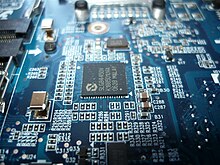
| Microprocessor |
Microelectronics engineering deals with the design and micro-fabrication of very small electronic circuit components for use in an integrated circuit or sometimes for use on their own as a general electronic component. The most common microelectronic components are semiconductor transistors, although all main electronic components (resistors, capacitors, inductors) can be created at a microscopic level. Nano electronics is the further scaling of devices down to nano-meter levels. Modern devices are already in the Nano-meter regime, with below 100 nm processing having been standard since about 2002.
Signal processing
Main article: Signal processing
 |
| A Bayer filter on a CCD requires signal processing to get a red, green, and blue value at each pixel. |
Signal Processing is a very mathematically oriented and intensive area forming the core of digital signal processing and it is rapidly expanding with new applications in every field of electrical engineering such as communications, control, radar, TV/Audio/Video engineering, power electronics and bio-medical engineering as many already existing analog systems are replaced with their digital counterparts. Analog signal processing is still important in the design of many control systems.
DSP processor ICs are found in every type of modern electronic systems and products including, SDTV | HDTV sets, radios and mobile communication devices, Hi-Fi audio equipment, Dolby noise reduction algorithms, GSM mobile phones, mp3 multimedia players, camcorders and digital cameras, automobile control systems, noise cancelling headphones, digital spectrum analyzers, intelligent missile guidance, radar, GPS based cruise control systems and all kinds of image processing, video processing, audio processing and speech processing systems.
Telecommunications
Main article: Telecommunications engineering
 |
| Satellite dishes are a crucial component in the analysis of satellite information. |
Once the transmission characteristics of a system are determined, telecommunication engineers design the transmitters and receivers needed for such systems. These two are sometimes combined to form a two-way communication device known as a transceiver. A key consideration in the design of transmitters is their power consumption as this is closely related to their signal strength. If the signal strength of a transmitter is insufficient the signal's information will be corrupted by noise.
Instrumentation
Main article: Instrumentation engineering
 |
| Flight instruments provide pilots the tools to control aircraft analytically. |
Often instrumentation is not used by itself, but instead as the sensors of larger electrical systems. For example, a thermocouple might be used to help ensure a furnace's temperature remains constant. For this reason, instrumentation engineering is often viewed as the counterpart of control engineering.
Computers
Main article: Computer engineering
 |
| Supercomputers are used in fields as diverse as computational biology and geographic information systems. |
Computer engineering deals with the design of computers and computer systems. This may involve the design of new hardware, the design of PDAs, tablets and supercomputers or the use of computers to control an industrial plant. Computer engineers may also work on a system's software. However, the design of complex software systems is often the domain of software engineering, which is usually considered a separate discipline. Desktop computers represent a tiny fraction of the devices a computer engineer might work on, as computer-like architectures are now found in a range of devices including video game consoles and DVD players.
Related disciplines
Mechatronics is an engineering discipline which deals with the convergence of electrical and mechanical systems. Such combined systems are known as electromechanical systems and have widespread adoption. Examples include automated manufacturing systems, heating, ventilation and air-conditioning systems and various subsystems of aircraft and automobiles.The term mechatronics is typically used to refer to macroscopic systems but futurists have predicted the emergence of very small electromechanical devices. Already such small devices, known as Microelectromechanical systems (MEMS), are used in automobiles to tell airbags when to deploy, in digital projectors to create sharper images and in inkjet printers to create nozzles for high definition printing. In the future it is hoped the devices will help build tiny implantable medical devices and improve optical communication.[34]
Biomedical engineering is another related discipline, concerned with the design of medical equipment. This includes fixed equipment such as ventilators, MRI scanners and electrocardiograph monitors as well as mobile equipment such as cochlear implants, artificial pacemakers and artificial hearts.

No comments:
Post a Comment